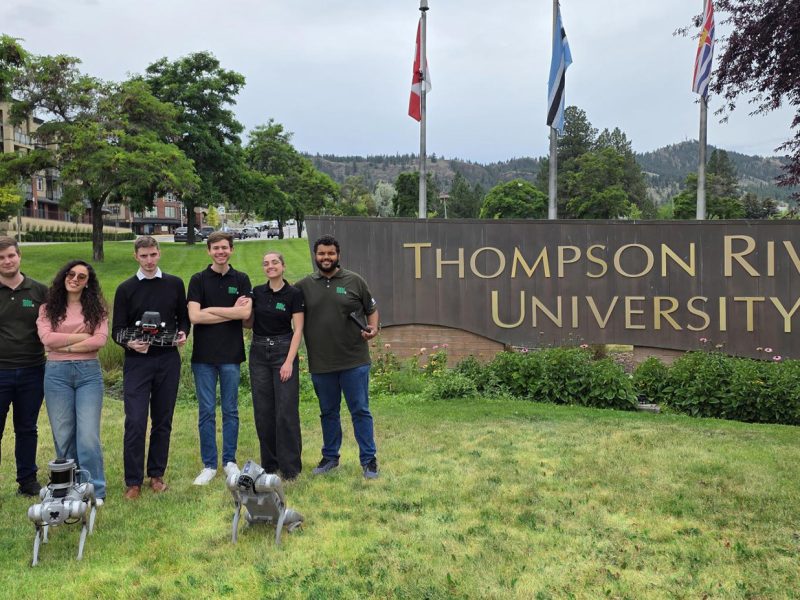
A summer of research: TRU welcomes record Mitacs cohort
Thirty visiting research students from around the globe took part in use-inspired research projects at TRU this summer through Mitacs.
Through hands-on learning, co-ops, internships, capstone projects and industry collaborations, you will work on engineering challenges that mirror the complexity and scope of professional practice.
Explore our programs
Engage in hands-on labs, experiments and projects to solve real world problems. Gain practical experience with industry partners through co-op. Network with industry professionals and get insights into latest trends and industry best practices.
Get peer support and learn in small class sizes. Receive academic and emotional support throughout the program and mentorship from professors.
The software engineering program meets the criteria of the Engineers Canada Accreditation Board and is accredited by EGBC (Engineers and Geoscientists BC).
If you want to be a professional with the technical knowledge and skills to design, develop, test and maintain software, a software engineering degree from TRU is the right choice.
Learn MoreGain the technical knowledge and skills to design, develop and integrate computer systems and their hardware and software components with a TRU computer engineering degree.
Learn moreAdvance your career, pivot into tech, or prepare for doctoral studies with a Master of Engineering Science that empowers you to engineer future-shaping solutions.
Learn moreJump-start your engineering studies with foundation courses in your first year at TRU, then transfer to UBC or UVic to complete your degree. You will also have the option to continue your studies at TRU by joining the second year of the BEnd Software Engineering program.
Learn More
Capstone projects are the culmination of the engineering journey and an influential opportunity for students to transform their knowledge, creativity and technical skills into practical solutions. These final-year projects challenge students to design, build and deliver innovative solutions to complex problems, often in collaboration with industry partners.
Learn More
Co-operative education is a mandatory requirement of the engineering degree that comes with many added benefits. In the fourth year of study, students complete two mandatory co-op work terms.
Benefits of Co-op:
Our program is designed to meet the criteria of the Engineers Canada Accreditation Board. Graduates will meet all the educational requirements for registration as a professional engineer through Engineers and Geoscientists British Columbia (EGBC). Up to 12 months of co-op work may count towards the work experience required for professional designation.
Learn more about co-opWith a computer or software engineering degree, you can step into several different fields including but not limited to artificial intelligence (AI), health care and medicine, data science manufacturing and automation industry, interactive entertainment, green technology, sustainable cities, social networking, transportation, self-driving automobiles, mining, education, bioinformatics and blockchain etc.
Career titles:
The average salary of computer or software engineer in Canada is $120,668 CAD per year or $61.88 per hour. Entry-level positions start at $87,750 per year, while most experienced workers make up to $147,767 per year.
Reference: https://ca.talent.com
To be eligible, you must:

The engineering program and university are two things I really believe in. I’m very excited to watch and help them grow.
— Lorelei Guidos Read more about the award
Thirty visiting research students from around the globe took part in use-inspired research projects at TRU this summer through Mitacs.
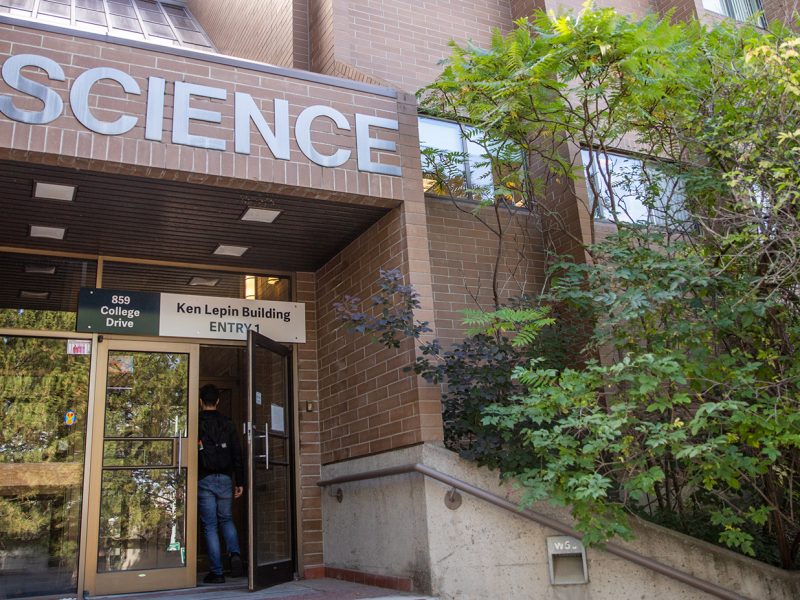
Four TRU researchers have been awarded more than $644,000 through the Natural Sciences and Engineering Research Council of Canada (NSERC).

Bachelor of Software Engineering student Ruth Solomon Befikadu excelled in three co-op terms by learning when to ask for help.
The demand for skilled engineers remains consistently high, driven by rapid technological change, infrastructure renewal and the race to solve complex global challenges. Employers are seeking professionals who can design solutions, integrate emerging technologies, and lead innovation in areas like automation, cybersecurity, data science and sustainable systems.
An engineering degree is more than a qualification, it’s a launchpad into a world of opportunities. Whether you envision yourself developing life-saving medical devices, building smart transportation networks, programming intelligent machines or advancing green energy solutions, your skills will be valued in every corner of the economy. As an engineer you won’t just adapt to the future, you’ll create it.
Five years, you must complete the first three years, one-year mandatory co-op (in your fourth year of the program) and the last year of the program to graduate.
Computer and software engineering are the most in-demand and fastest growing professions in North America with strong job growth projected over the next decade. Companies such as Google, Amazon, Facebook, IBM, Apple, Intel and BlackBerry hire computer and software engineers to help them stay at the leading edge of technology and innovation. Computer and software engineers have been working in industry in a wide variety of roles like Network and Systems engineer, Software architect, Cybersecurity Software specialist, AI engineer, Test Automation engineer, Embedded systems engineer, System analyst and many more.
Tuition at TRU is among the lowest in British Columbia as compared to several other provinces,— but that’s not all. You’ll find many financial supports to ease your way on your educational journey. Please visit, TRU's Tuition and Fees page to learn more about your academic expenses and options for financial support.
For your application to be considered complete, your official transcript must be received by the TRU Admissions Office. For more info, please visit our website page, How to submit Transcripts and Documents?
A city of about 100,000, Kamloops offers a warm and dry climate with over 2,000 hours of sunshine and the enriched community that includes cultural diversity. TRU campus is set on 250 acres with stunning views of the North and South Thompson Rivers. Our main campus in the heart of our community offers plenty of opportunities to live, work, play and learn. Please watch our informative Video Tours to find out more.
The engineering programs are competitive with limited seats, 40 for software and computer engineering and 60 for the transfer program.
Yes! Co-operative education is a requirement for graduation. During your co-op experience you will receive paid and relevant work experience, allowing you to apply theory learned in the classroom, explore interests related to the field of study and advance skills as a professional while strengthening your resumé. In the fourth year of study, students are required to complete two mandatory co-op work terms.
You should meet with the program advisor a few weeks before the semester begins, and whenever you feel in need of program related advising throughout your academic progress. To book an appointment, please email engr@tru.ca and include your name and student number in your email.
To assist you with proper course selection and program planning. The engineering advisor will also provide referrals when necessary. We want to keep you on track for graduation.
Ready to take the next step in your journey? Connect with a future student advisor to explore numerous program options at TRU and get personalized guidance on your application. Our advisors are here to support you in finding the right path for your needs.
TRU begins accepting applications for most programs on October 1. For fall intake, the application deadline is May 1. For winter intake, the deadline is Sept. 1. For summer intake, the deadline is Jan. 1. Some programs continue accepting applications if space is available.